复仇者联盟2
US Pentagon official’s Manila speech exposes alliance fragility, with Philippines likely to bear costs of provocations: Chinese expert_我的网站

一 |
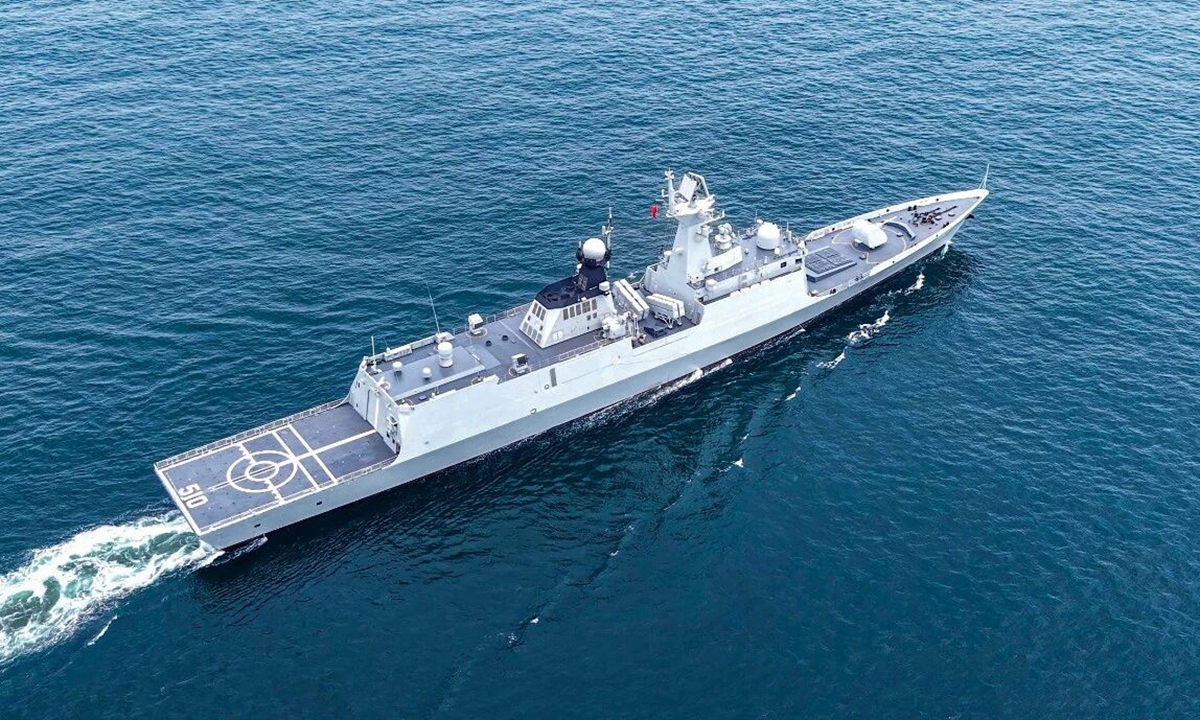
Image of the PLA Navy Type 054A guided missile frigate
Ningde Photo: China Military BugleState media released footage on Saturday showing the latest training scenes of the Type 054A guided missile frigate Ningde, marking its official commissioning into the Chinese People's Liberation Army (PLA) Navy.
The vessel inherits the hull number 510 from its predecessor, a smaller Type 056 guided missile corvette also named
Ningde.
Recently, the
Ningde, assigned to a frigate flotilla under the PLA Eastern Theater Command, formed a task group with multiple vessels to conduct combat-oriented training, testing command coordination and emergency response capabilities while accelerating combat readiness generation, according to the military channel of state broadcaster CCTV News.
As threats emerged from both sea and air, radar stations quickly locked onto targets and reported the tactical situation. Weapons systems prepared for engagement. Following the commander's order, the main and secondary guns opened fire in succession, delivering intensive strikes and neutralizing the simulated threats, the report said.
Amid rolling waves, the vessel conducted replenishment drills. Subsequently, the
Ningde focused on specialized training in areas including helicopter takeoffs and landings and damage control, further honing its combat skills, said the report.
The new Ningde has drawn attention from Chinese military enthusiasts, who remarked that the PLA Navy's modernization is moving at an astonishing pace, as the previous Type 056 Ningde had been in service for only about a decade, according to Shanghai Observer.
The continued production and upgrade of the Type 054A have effectively filled the gap in coastal and offshore combat capabilities, providing the navy with a large number of cost-effective platforms for both near-sea and far-sea operations, helping maintain a sustained combat readiness, Zhang Junshe, a Chinese military affairs expert, told the Global Times on Sunday.
Mass production has reduced unit procurement and maintenance costs, standardized training, logistics and command systems, and significantly improved the overall efficiency of the Navy's equipment system, Zhang said.
The Type 054A guided missile frigate belongs to the PLA Navy's most numerous and cost-effective medium-sized frigate program of the past two decades, often described as a "maritime multi-role platform."
With the addition of the
Ningde, the Type 054A fleet has now reached 46 vessels, Zhang said.
The Type 054A is equipped with 3D radar, low-altitude gap-filling radar and a towed array sonar system, forming a three-dimensional detection network covering sea, air and underwater domains. With a range of 4,000 nautical miles, it is suited for long-duration far-sea missions and possesses strong integrated combat capabilities in coastal and offshore waters, as well as far-sea escort capabilities. Its weapon systems are well balanced through successive upgrades, Zhang said.
In January 2026, CCTV announced a newly upgraded version of Type 054A frigates.
Compared with the original design, the upgraded version features an extended flight deck better suited for new shipborne helicopters, addressing a previous shortfall in aviation-based anti-submarine warfare. The main gun has also been upgraded to a 100mm caliber, similar to that on the Type 054B, with improved radar range and accuracy.
PLA Navy has developed the Type 054B frigate as a next-generation successor to the Type 054A.
On January 22, 2025, the lead ship of the Type 054B,
Luohe, was commissioned at a naval port in Qingdao, East China's Shandong Province, followed by the second ship,
Qinzhou, in March, reported CCTV.
The Type 054B frigate displaces approximately 5,000 tons and features a new propulsion system, stealth design, integrated mast and advanced multi-functional vertical launch system capable of firing various missile types. It has achieved breakthroughs in stealth technology, combat command systems and fire control integration, said the CCTV report.
Despite this, China continues to upgrade and build the Type 054A frigate. Zhang said that the Type 054A and Type 054B form a clear "high-low mix, mission complement" structure.
The Type 054B is positioned as a larger far-sea vessel, primarily tasked with core escort and high-end confrontation missions in far-sea formations. The Type 054A serves as the main coastal and offshore combat force and a supplementary far-sea asset, responsible for near-sea defense, routine patrols, anti-submarine warfare in offshore waters, and escort missions for far-sea formations. This avoids equipment homogenization and enables efficient synergy, Zhang said.
The Type 054A features mature technology, stable production lines, fast construction and high cost-effectiveness, enabling rapid mass deployment at relatively low cost. Meanwhile, the Type 054B, as a new model, still comes with a higher price tag.
Given the Navy's continuous demand for more vessels, continued construction of the Type 054A quickly fills the coastal and offshore capability gap, while the Type 054B gradually replaces some older vessels and enhances far-sea integrated combat capabilities, Zhang noted.
。

Illustration: Liu Rui/GTUS Pentagon official Elbridge Colby's latest Manila speech, in which he called on allies to "invest more" in their own defense and stressed that Washington wants "partners, not protectorates," has drawn attention from some Philippine media. Colby's claims also expose the fragility of the Manila-Washington alliance and Washington's push to enlist "Indo-Pacific" allies in serving its own strategic interests, a Chinese expert said, warning that the Philippines, by placing itself on the front line of provocations against China, risks being a geopolitical pawn left to bear the consequences on its own.
While delivering a speech at the Stratbase Institute in Manila, Philippines, on Monday, Colby, the Under Secretary of War for Policy, laid out the US' so-called "flexible realism" approach to the Indo-Pacific, stressing that the US is "definitely not disengaging from Asia" but strengthening its forward posture and seeking to build a "denial defense" along the First Island Chain, according to a transcript of the speech released on the US Department of War website.
At the same time, he called on US allies and partners to step up, invest more in their own defense, and take responsibility for their own sovereign security. "We are looking for partners, not protectorates," Colby claimed.
The claims have drawn attention from some Philippine media outlets, with some linking them to the South China Sea issue. However, the transcript of Colby's speech showed that he did not mention China, the Global Times found.
A Manila Bulletin report noted that after calling on allies to invest more in defense, Colby cited the Philippines as an example of the "kind of partner Washington wants to work with." He praised Manila for "strengthening its military and coast guard capabilities while deepening operational cooperation with the US" amid what the report described as China's "aggression" in the South China Sea.
Colby's visit to Manila marked his first official trip to Southeast Asia as an undersecretary under the Trump administration. He is scheduled to travel from Manila to Jakarta, Indonesia; Bangkok, Thailand; and Phnom Penh, Cambodia, said the report.
Meanwhile, a Manila Standard report interpreted Colby's remarks as showing that "the US is working closely with the Philippines" to strengthen Manila's military capabilities and protect its sovereign rights in the South China Sea, despite the fact that Colby did not mention China in his speech.
The US appears to be adopting a more retrenchment-style approach, shifting from leading directly to relying on regional allies to take the frontline role while providing support. This approach allows Washington to advance its interests while lowering its own costs, Song Zhongping, a Chinese military affairs expert, told the Global Times.
Song noted that Washington seeks to use repeated maritime frictions to tie down Chinese resources, which helps explain Colby's praise for Manila: the Philippines bears part of Washington's strategic burden while receiving largely rhetorical US support.
A South China Morning Post report on Tuesday noted that Colby avoided mentioning the recent disputes over Huangyan Dao, despite Washington having criticized China's establishment of a nature reserve there just two days earlier. The report described the omission as a "measured tone" ahead of a potential meeting between the Chinese and US leaders.
Washington's primary concern is its own interests. At the core of its "Indo-Pacific strategy" is strengthening its alliance network by pushing partners such as the Philippines to shoulder greater security burdens in pursuit of US strategic goals. As US-China diplomatic dynamics evolve, countries serving as Washington's geopolitical spearheads in confrontations with China risk being left behind, said some observers.
Song noted that this also reveals the fragility of the US-Philippine relationship.
The US has encouraged the Philippines to take the front line in confrontations with China while offering mostly rhetorical support. Should tensions escalate, Manila would bear much of the cost on its own, said the expert.
。
Current article:http://zxuirk.foujiongwenruapoumeizhan.buzz/qyzg1o/20260826/48827.html
Published on:21:00:44